LHDN e-Invoice Update 2026: RM3 Million Exemption and What SMEs Need to Know

Turn Your HRD Corp Allocation into Better Workforce Performance with Biztrak Training Courses
August 27, 2026
LHDN e-Invoice Update 2026: RM3 Million Exemption and What SMEs Need to Know
Malaysia’s e-Invoice landscape has taken another important turn, with the Inland Revenue Board of Malaysia (LHDN/IRBM) issuing the latest e-Invoice Guideline Version 4.8 on 30 August 2026.
For Malaysian SMEs, the headline change is significant: businesses with annual turnover or revenue of less than RM3 million are now exempt from issuing e-Invoices, subject to specific conditions.
The increase from the previous RM1 million threshold provides welcome relief for many smaller businesses. However, SMEs should not assume that being below RM3 million automatically means they are exempt.
Under the latest guideline, shareholding, holding-company, related-company and joint-venture structures can affect eligibility for the exemption.
For business owners, the key question is therefore no longer simply, “How much is my annual revenue?” It is also, “What is my business structure?”
RM3 Million Becomes the Key e-Invoice Exemption Threshold
Under Section 1.6.1 of the latest e-Invoice Guideline, taxpayers with annual turnover or revenue of less than RM3 million are exempt from issuing e-Invoices, including self-billed e-Invoices.
This is an important change for SMEs whose annual revenue falls between RM1 million and RM3 million.
Previously, businesses in this range would have been affected by the e-Invoice implementation requirements. Under Version 4.8, qualifying businesses below RM3 million may now fall within the exemption.
For tax purposes, businesses covered by the exemption can continue using receipts or other existing documents as proof of expenses.
However, there are important exceptions.
SMEs Below RM3 Million May Still Need to Implement e-Invoice.
One of the most important clarifications in Version 4.8 is that the RM3 million exemption does not apply universally based on a company's own turnover.
The exemption does not apply where:
- ● The taxpayer has a non-individual shareholder or equivalent with annual turnover or revenue of at least RM3 million;
- ● The taxpayer is a subsidiary of a holding company with annual turnover or revenue of at least RM3 million; or
- ● The taxpayer has a related company or joint venture with annual turnover or revenue of at least RM3 million.
This is particularly relevant for SMEs operating within corporate groups.
Why business structure matters
Consider an SME with annual revenue of RM2 million.
If it is an independently operated business with no qualifying corporate relationship, it may fall within the RM3 million exemption.
But if the same RM2 million business is a subsidiary of a larger holding company with annual revenue exceeding RM3 million, it would not qualify for the exemption under the conditions set out in Version 4.8.
The takeaway for SME owners is simple: don't assess e-Invoice eligibility based on your company's turnover alone.
Review your shareholding, group structure and related business relationships as well.
What About SMEs With RM3 Million to RM5 Million Revenue?
For businesses with annual turnover or revenue of RM3 million and above, the new exemption does not provide relief simply because they are below RM5 million.
The latest guideline continues to list taxpayers with annual turnover or revenue of up to RM5 million under the Phase 4 implementation date of 1 January 2026.
Therefore, SMEs with revenue between RM3 million and RM5 million should continue to meet their e-Invoice obligations.
This distinction is important because the RM3 million threshold is an exemption threshold, while the existing implementation timeline also refers to the wider group of taxpayers with turnover or revenue up to RM5 million.
Businesses should therefore determine their status based on the detailed rules in the latest LHDN guideline rather than assuming that the Phase 4 threshold has simply moved from RM5 million to RM3 million.
Already Using e-Invoice? Don't Switch Off Too Quickly
Another practical issue concerns businesses that have already implemented e-Invoice.
Some SMEs with annual revenue between RM1 million and RM3 million may already have invested in accounting software, processes and staff training to comply with e-Invoice requirements.
Version 4.8 states that taxpayers can voluntarily participate in e-Invoice implementation earlier, regardless of their annual turnover or revenue.
The latest guideline does not specifically set out a process for businesses that were already implementing e-Invoice under the previous threshold to discontinue their existing arrangements following the increase to RM3 million.
For businesses in this situation, it may therefore be more practical to continue monitoring LHDN's clarification before making changes to established accounting workflows.
After all, switching systems or processes on and off can create unnecessary disruption, particularly for SMEs that have already integrated e-Invoice into their accounting operations.
New Businesses Also Need to Watch the RM3 Million Mark
Version 4.8 also provides updated rules for new businesses.
For businesses or operations commencing between 2023 and 2025 with annual turnover or revenue of at least RM3 million, the implementation date is 1 July 2026.
For businesses commencing from 2026 onwards, the implementation date is 1 July 2026 or the date operations commence.
Where the first year's turnover or revenue is expected to be below RM3 million, the implementation date is linked to the year in which the business reaches the RM3 million threshold, with the guideline specifying implementation from 1 January in the second year following the year in which RM3 million is reached.
For startups and newly established SMEs, keeping track of revenue growth will therefore be important as the business approaches the threshold.
The e-Invoice Implementation Timeline
The broader phased implementation timeline remains as follows:
| Taxpayer Annual Turnover / Revenue/th> | Implementation Date |
|---|---|
| More than RM100 million | 1 August 2024 |
| More than RM25 million to RM100 million | 1 January 2025 |
| More than RM5 million to RM25 million | 1 July 2025 |
| Up to RM5 million | 1 January 2026 |
Importantly, LHDN states that once a taxpayer's implementation timeline has been determined, subsequent changes in annual turnover or revenue do not change the taxpayer's implementation obligation.
This makes it important for businesses to understand their applicable implementation status rather than relying solely on their current-year revenue.
MyInvois Portal or API: Which Option Is Right for Your SME?
For businesses that remain subject to e-Invoice, LHDN provides two main transmission mechanisms: MyInvois Portal and API integration.
1. MyInvois Portal
The MyInvois Portal enables taxpayers to generate e-Invoices individually or through batch generation using spreadsheet uploads.
For SMEs with a relatively small volume of transactions, this can provide a straightforward way to issue e-Invoices without investing heavily in system integration.
2. API Integration
Businesses handling higher transaction volumes can integrate their accounting or ERP system directly with the MyInvois System through an API.
The API can also be implemented through Peppol or non-Peppol technology providers.
For growing SMEs, an integrated accounting system can provide a more efficient approach by reducing duplicate data entry and connecting invoicing with existing sales, purchase and accounting processes.
Why SMEs Should Look Beyond Compliance
For many SME owners, e-Invoice may initially be viewed as another regulatory requirement.
But the transition also presents an opportunity to improve the way the business manages its financial information.
A properly integrated accounting system can help businesses:
- ● Reduce manual invoice processing;
- ● Minimise duplicate data entry;
- ● Improve the accuracy of financial records;
- ● Streamline sales and purchase documentation;
- ● Maintain better transaction visibility;
- ● Prepare information required for e-Invoice submission; and
- ● Reduce the administrative burden as the business grows.
LHDN's guideline provides for e-Invoices to be transmitted through the MyInvois Portal or API, with businesses responsible for ensuring that the information submitted is complete and accurate.
For SMEs, this makes accounting system readiness an important part of e-Invoice preparation, rather than treating e-Invoice as an isolated invoicing exercise.
How Biztrak Can Help SMEs Prepare
For SMEs that need to comply with e-Invoice requirements, having an accounting system that supports the business's day-to-day financial processes can make the transition more manageable.
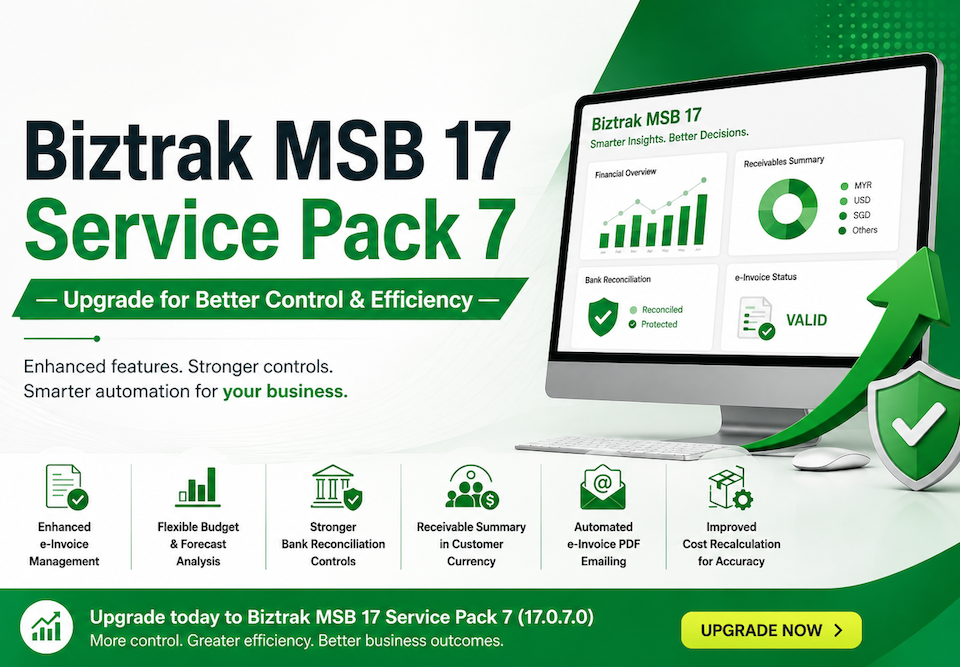
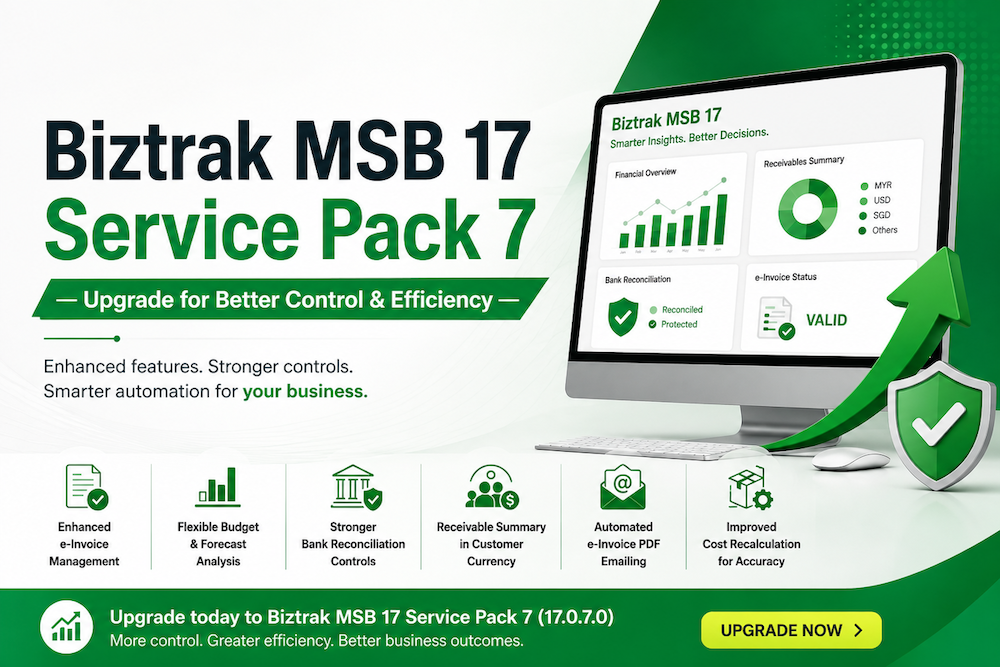
Both Biztrak MSB accounting software and Biztrak Online Cloud Accounting provide essential accounting functions, including General Ledger, Sales, Purchase, Cash Management, Fixed Assets, Tax Management and e-Invoicing. Together, they offer businesses a comprehensive accounting solution to manage day-to-day financial operations while supporting Malaysia’s evolving e-Invoice requirements..
By connecting accounting processes within one system, SMEs can reduce reliance on disconnected spreadsheets and manual processes while preparing their financial data for digital reporting requirements.
For businesses that need more comprehensive integration, Biztrak's e-Invoice capabilities can help streamline the flow from business transactions to e-Invoice submission, allowing businesses to manage their accounting and compliance requirements within a more structured workflow.
The objective is not simply to "do e-Invoice", but to build a more efficient financial management process that can scale with the business.
A Practical e-Invoice Checklist for Malaysian SMEs
With Version 4.8 now in effect, SME owners can take the following steps:
1. Check your annual turnover or revenue
Determine whether your business is below or above the RM3 million exemption threshold.
2. Review your corporate structure
Check your shareholders, holding company, related companies and joint ventures against the conditions specified by LHDN.
3. Confirm your e-Invoice status
If your business is already implementing e-Invoice, review the latest LHDN guidance before making changes.
4. Review your accounting system
Assess whether your current accounting software can support your e-Invoice requirements and future business growth.
5. Clean up your financial data
Ensure customer, supplier, company and transaction information is accurate and complete.
6. Plan ahead
Even businesses currently exempt from e-Invoice should monitor their revenue and business structure as they grow.
What the Latest Update Means for SME Owners
The increase of the e-Invoice exemption threshold to RM3 million is undoubtedly welcome news for many Malaysian SMEs.
However, the latest LHDN update also highlights an important reality: e-Invoice compliance is not determined by revenue alone.
Business owners need to consider their corporate structure, group relationships and existing implementation status before deciding whether the exemption applies to them.
For SMEs that remain within the e-Invoice regime, the focus should now move beyond compliance alone. The right accounting system and digital processes can help turn e-Invoice from an administrative obligation into an opportunity to improve financial visibility, reduce manual work and build a more scalable business operation.
As Malaysia continues its transition towards digital tax administration, staying updated with LHDN's latest requirements—and having the right accounting infrastructure in place—will be increasingly important for SMEs.
Source: Inland Revenue Board of Malaysia (LHDN/IRBM), e-Invoice Guideline Version 4.8, published 30 August 2026.
This article is intended for general information only and does not constitute tax, accounting or legal advice. Businesses should refer to the latest LHDN guidance or consult a qualified tax professional for advice specific to their circumstances.
For the latest official information, refer to the E-INVOICE GUIDELINE (VERSION 4.8) published by LHDN. If you have questions about implementing or upgrading your e-Invoice solution, the Biztrak team is ready to help your business stay compliant with confidence.