Budget 2027 Malaysia: Key Highlights for SMEs, Taxpayers and Households

How Biztrak Accounting Software Helps Businesses Manage Tax Records in Malaysia
October 2, 2026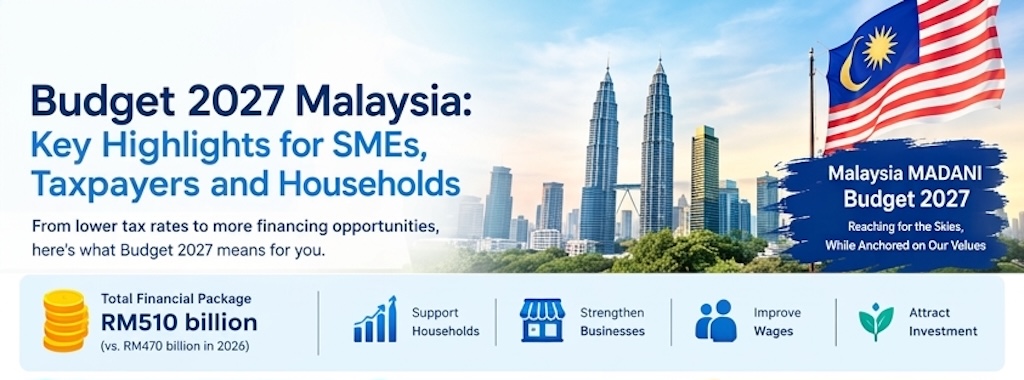
Budget 2027 Malaysia: Key Highlights for SMEs, Taxpayers and Households
Malaysia’s Fifth MADANI Budget 2027 was tabled by Prime Minister and Finance Minister YAB Dato’ Seri Anwar Ibrahim on 9 October 2026.
With the theme “Reaching for the Skies, While Anchored on Our Values”, the Budget focuses on easing the cost of living, supporting businesses, improving wages and attracting investment.
The Government has outlined a total financial package of RM510 billion for 2027, compared with RM470 billion previously. The package includes Federal Government expenditure and investments by government-linked investment companies, statutory bodies and public-private partnerships.
For Malaysian businesses, particularly micro, small and medium enterprises (MSMEs), the Budget introduces several measures worth understanding. These include lower business income tax rates, increased capital allowance limits and financing support.
Individuals will also see changes to income tax reliefs, tax rates and housing incentives.
Here are the key Malaysia Budget 2027 highlights and what they mean for you.
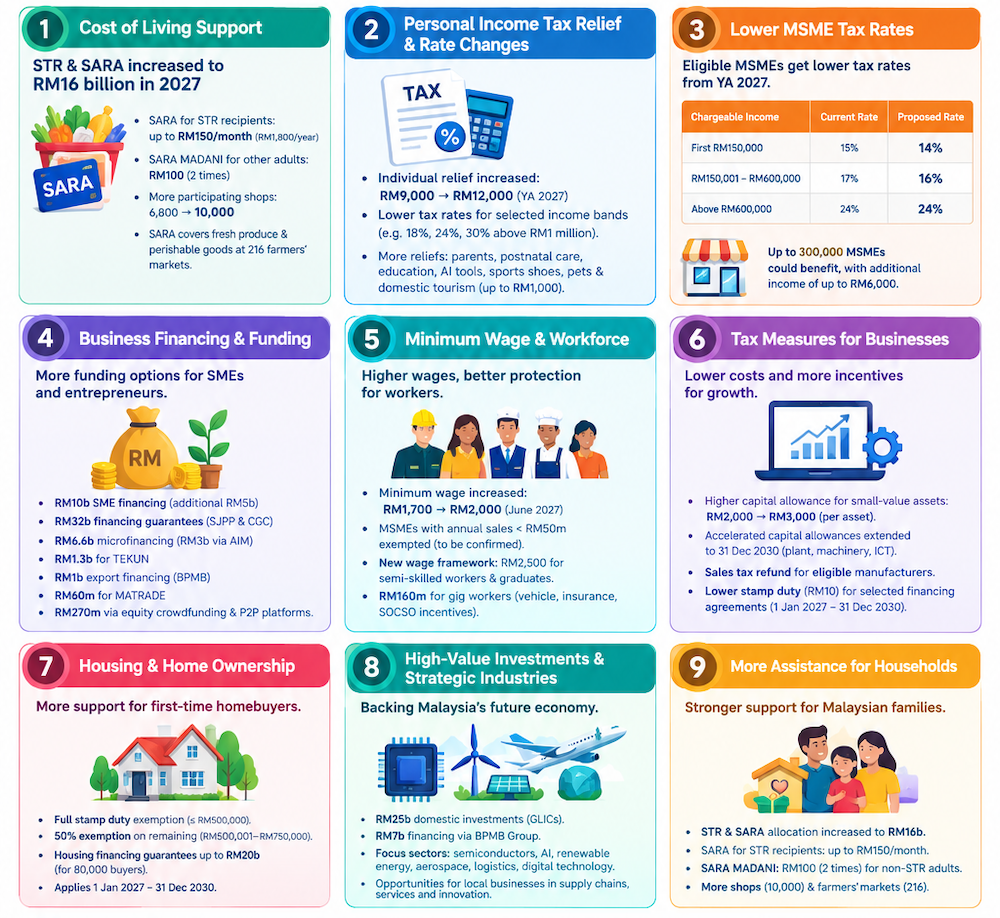
1. Budget 2027: Key Highlights at a Glance
The most important announcements include:
- ● Lower MSME income tax: The proposed tax rates for eligible MSMEs will decrease from 15% to 14% for the first RM150,000 of chargeable income, and from 17% to 16% for the next RM450,000.
- ● Higher personal tax relief: Individual income tax relief for individuals and dependent relatives will increase from RM9,000 to RM12,000 from Year of Assessment (YA) 2027.
- ● Revised individual tax rates: Selected income tax bands will benefit from lower rates, while the top 30% rate will apply to chargeable income exceeding RM1 million.
- ● More SME financing: Financing facilities and guarantees will expand to support businesses, including SMEs seeking to grow or enter export markets.
- ● Higher minimum wage: The minimum wage will increase from RM1,700 to RM2,000 per month from June 2027, with an announced exemption for MSMEs with annual sales below RM50 million.
- ● More favourable capital allowances: The qualifying value for small-value assets will increase from RM2,000 to RM3,000 per asset.
- ● More support for households: STR and SARA assistance will increase to RM16 billion in 2027.
- ● More investment opportunities: The Government will support strategic industries such as semiconductors, artificial intelligence (AI), renewable energy, aerospace and digital technology.
Let’s look at these measures in more detail.
2. MSME Tax Rate 2027: Lower Income Tax for Eligible Businesses
One of the biggest announcements for business owners is the proposed reduction in MSME income tax rates.
MSMEs play an important role in Malaysia’s economy. According to the Budget speech, they contribute approximately 40% of the economy and employ eight million people.
The Government aims to help these businesses manage rising operating costs and retain more earnings for growth.
What are the new MSME income tax rates?
| Chargeable income | Current rate | Proposed rate |
|---|---|---|
| First RM150,000 | 15% | 14% |
| RM150,001–RM600,000 | 17% | 16% |
| Above RM600,000 | 24% | 24% |
The new rates are proposed to take effect from YA 2027.
The Government estimates that approximately 300,000 MSMEs could benefit, with additional income of up to RM6,000.
Who qualifies?
The proposed rates apply to eligible MSMEs meeting the prescribed conditions. These include:
- ● Companies with paid-up capital of RM2.5 million or below.
- ● Limited liability partnerships (LLPs) with partnership capital contributions of RM2.5 million or below.
- ● Annual sales not exceeding RM50 million.
Other eligibility requirements may apply. Businesses should check the final rules before calculating their tax liabilities.
What should business owners do?
- ● Review your company's eligibility for the revised tax rates.
- ● Estimate your YA 2027 tax position.
- ● Keep your sales, expense and accounting records up to date.
- ● Consider how any tax savings could support working capital, equipment purchases or business expansion.
Remember that these rates apply to chargeable income, not total sales revenue.
3. Budget 2027 Tax Measures: More Savings on Business Assets
Besides lower MSME income tax rates, Budget 2027 proposes changes to capital allowances and selected business taxes.
Higher capital allowance for small-value assets
The qualifying value limit for each small-value asset will increase from RM2,000 to RM3,000 from YA 2027.
For companies that are not MSMEs, the overall annual claim limit will increase from RM20,000 to RM30,000.
Eligible MSMEs can continue to claim capital allowances on qualifying small-value assets without an overall annual limit, subject to the applicable conditions.
This could benefit businesses purchasing equipment, office fittings and other qualifying assets.
Continued incentives for technology investment
Accelerated Capital Allowances for qualifying expenditure on locally produced plant and machinery, as well as information and communications technology (ICT) equipment and software, will be extended until 31 December 2030.
This gives businesses a longer planning period for eligible investments in technology and productivity improvements.
However, not every software or equipment purchase automatically qualifies. Check the relevant tax conditions before making investment decisions.
Sales tax refunds for eligible manufacturers
Manufacturers will be able to reclaim sales tax on qualifying machinery, spare parts and equipment purchased from local traders or distributors.
The facility will also cover specified raw materials used to produce pharmaceuticals, animal feed, fertilisers and pesticides.
This measure aims to reduce qualifying input costs and support local manufacturing.
Lower stamp duty for selected financing agreements
From 1 January 2027 to 31 December 2030, the Government proposes a RM10 stamp duty rate for eligible agreements involving the utilisation of excess bank credit facilities and loans obtained through peer-to-peer (P2P) financing platforms.
These measures could help eligible businesses manage selected financing costs and cash flow.
4. SME Financing Malaysia 2027: More Funding Opportunities
Access to financing remains important for businesses managing daily expenses, purchasing equipment or expanding into new markets.
Budget 2027 introduces several initiatives to support businesses at different stages of growth.
Key financing announcements
- ● RM10 billion in SME financing: Bank Negara Malaysia will provide an additional RM5 billion on top of the initial RM5 billion facility to support SMEs affected by the West Asia conflict.
- ● RM32 billion in financing guarantees: The Small Debt Guarantee Corporation (SJPP) and Credit Guarantee Corporation Malaysia (CGC) will provide financing guarantees of up to RM32 billion in 2027.
- ● RM6.6 billion in microfinancing: The allocation will support micro-entrepreneurs and smaller businesses.
- ● RM3 billion through Amanah Ikhtiar Malaysia: This funding is expected to support approximately 360,000 entrepreneurs.
- ● RM1.3 billion for TEKUN: The financing fund will increase to support entrepreneurs, particularly Bumiputera businesses.
- ● RM1 billion for export financing: Bank Pembangunan Malaysia will support local MSMEs looking to enter overseas markets.
- ● RM60 million for MATRADE: The allocation will help Malaysian companies access new international markets and diversify export destinations.
The Government also plans to allocate RM270 million to support SMEs, mid-tier companies and social enterprises through equity crowdfunding and P2P financing platforms.
What does this mean for your business?
These initiatives may offer additional funding options for businesses with suitable expansion plans.
Before applying, consider:
- ● The amount of funding your business needs.
- ● Whether the financing is suitable for working capital or long-term investment.
- ● Your business's repayment capacity.
- ● The eligibility requirements and application process.
Financing can support growth, but businesses should assess the costs and risks before taking on new commitments.
5. Minimum Wage Malaysia 2027: What Employers Should Know
Budget 2027 announces an increase in the minimum wage from RM1,700 to RM2,000 per month, effective June 2027.
The Government has stated that MSMEs with annual sales below RM50 million will be exempted to allow them more time to adjust their business models.
Employers should monitor the final implementation rules and confirm whether their businesses qualify for the exemption.
A new wage framework
The Government also plans to reform the workers' income framework, beginning with a minimum wage of RM2,500 per month for semi-skilled workers and graduates.
Separately, government-linked investment companies and government-linked companies will raise their living wage benchmark from RM3,100 to RM3,400 per month.
How should businesses prepare?
Higher wage costs can affect monthly cash flow, particularly for businesses with large workforces.
Employers should:
- ● Review payroll budgets and salary structures.
- ● Forecast the impact on operating expenses.
- ● Assess staffing needs and productivity.
- ● Review pricing and business margins where necessary.
- ● Monitor official announcements on wage requirements and exemptions.
Accurate payroll and accounting records will help businesses understand the impact and plan ahead.
6. Budget 2027 Malaysia: Personal Income Tax Relief and Rate Changes
The Budget also introduces proposed changes to personal income tax for resident individuals from YA 2027.
These measures aim to ease financial pressure, especially for middle-income earners.Higher individual income tax relief
The personal income tax relief for individuals and dependent relatives will increase from RM9,000 to RM12,000.
This increases the amount that eligible taxpayers can deduct when calculating chargeable income.
The actual tax savings will depend on each taxpayer's income and circumstances.
Revised individual income tax rates
Selected chargeable income bands will benefit from lower rates.
| Chargeable income | Proposed tax rate |
|---|---|
| RM70,001–RM100,000 | 18% |
| RM100,001–RM150,000 | 24% |
| RM150,001–RM400,000 | 25% |
| RM400,001–RM600,000 | 26% |
| RM600,001–RM1 million | 28% |
| Above RM1 million | 30% |
The rates apply progressively to the relevant portions of chargeable income. They are not applied to a taxpayer's entire income at a single rate.
The Government estimates that the combined changes to personal tax rates and reliefs could provide approximately five million taxpayers with additional disposable income of up to RM1,600.
More individual tax reliefs
Other proposed changes include:
- ● Parents and grandparents: A broader scope of qualifying care expenses.
- ● Health and well-being: Inclusion of qualifying postnatal care services, with a specific RM3,000 limit under the relevant relief.
- ● Education and skills training: An expanded scope of eligible education and tuition expenses.
- ● Lifestyle expenses: Eligible AI software and application subscriptions for personal use will be included within the existing RM2,500 lifestyle relief limit.
- ● Pet care: Qualifying adoption fees from registered animal shelters and registered veterinary services for vaccination and spaying or neutering.
- ● Sports-related expenses: Expansion to include sports shoes under the relevant relief conditions.
The Budget also proposes extending individual income tax relief of up to RM1,000 for qualifying domestic tourism expenses to YA 2027.
Taxpayers should retain supporting documents and refer to the final Inland Revenue Board of Malaysia (IRBM) guidance before claiming these reliefs.
7. Cost of Living: More Assistance for Malaysian Households
Budget 2027 increases the allocation for Sumbangan Tunai Rahmah (STR) and Sumbangan Asas Rahmah (SARA) to RM16 billion in 2027, compared with RM15 billion previously.
The main measures include:
- ● SARA for STR recipients: Assistance of up to RM150 per month, or RM1,800 annually, for eligible recipients.
- ● SARA MADANI: RM100 assistance on two occasions for Malaysians aged 18 and above who are not STR recipients.
- ● More participating retailers: The number of small grocery shops in the SARA network will increase from 6,800 to 10,000.
- ● More affordable groceries: SARA will be extended to fresh produce and perishable goods at 216 participating farmers' markets and tamu nationwide.
These initiatives aim to help households manage essential expenses while extending opportunities to participating local retailers.
For small businesses, wider participation in these programmes may provide another way to reach customers, subject to the relevant requirements.
8. Housing and High-Value Investments: Other Budget 2027 Highlights
Two additional areas are worth noting: home ownership and investment in industries that can support Malaysia's future growth.
Stamp duty exemptions for first-time homebuyers
The Government proposes the following stamp duty exemptions for eligible first homes:
The measure will apply to qualifying sale and purchase agreements executed from 1 January 2027 to 31 December 2030.
More investment in high-value industries
Government-linked investment companies will mobilise RM25 billion in domestic investments.
The Budget also includes RM7 billion in financing across strategic sectors through the BPMB Group, including:
- ● Semiconductors and electrical and electronics.
- ● Artificial intelligence and digital technology.
- ● Renewable energy.
- ● Aerospace and logistics.
These investments may create opportunities for Malaysian businesses involved in manufacturing, technology, professional services and related supply chains.
For companies planning to expand, investing in productivity, digital capabilities and workforce skills can help them prepare for emerging opportunities.
9. What Should Businesses Do After Budget 2027?
Understanding the Budget is only the first step. Business owners should identify which measures apply to their operations and translate them into practical plans.
Here is a simple checklist.
Review your tax position.
- ● Check your eligibility for the revised MSME income tax rates.
- ● Identify qualifying capital allowances and other tax measures.
- ● Keep supporting documents for tax claims.
Strengthen your financial records.
- ● Record sales, expenses, purchases and payments accurately.
- ● Monitor cash flow and outstanding receivables.
- ● Review monthly financial reports to understand your business performance.
Prepare your payroll budget.
- ● Review salary structures and staffing costs.
- ● Monitor minimum wage implementation requirements.
- ● Assess ways to improve productivity and control operating costs.
Explore financing opportunities.
- ● Identify suitable funding or guarantee programmes.
- ● Prepare financial statements and supporting documents.
- ● Assess repayment capacity before committing to financing.
Plan your investments.
- ● Evaluate whether new equipment or software can improve productivity.
- ● Review qualifying tax incentives before making major purchases.
- ● Set clear budgets and expected returns for business expansion.
Good financial management makes it easier to assess opportunities, control costs and prepare for regulatory changes.
Conclusion: Turn Budget 2027 into a Business Advantage
The Fifth MADANI Budget 2027 provides several measures aimed at supporting Malaysian households, strengthening MSMEs and encouraging higher-value investment.
For businesses, the proposed reduction in MSME income tax rates, expanded financing facilities and revised capital allowances are important announcements to review.
For individuals, higher personal tax relief, revised income tax rates and additional assistance may help ease financial pressure.
However, the actual benefits will depend on eligibility, final implementation rules and how businesses and individuals prepare.
Now is a good time to review your accounts, assess your tax position and plan your next business move.
At Biztrak, we understand the importance of organised financial information for better business decisions. The right accounting processes can help businesses monitor performance, manage cash flow and prepare for tax and reporting requirements.
Speak to Biztrak to learn how accounting software can support your business's day-to-day financial management and future growth.
Disclaimer: This article summarises key announcements in the Fifth MADANI Budget 2027 speech and the Ministry of Finance's Tax Measures document as at 12 October 2026. Proposed measures are subject to applicable legislation, final implementation details and official guidance. Please consult the relevant authorities or a qualified tax professional for advice on your specific circumstances.